 ZAR
 KES - Kenya
 UGX - Uganda
 TZS - Tanzania
 RWF - Rwanda
 NGN - Nigeria
 USD - Zimbabwe
 GHS - Ghana
 ETB - Ethiopia
 ZMW - Zambia
 USD - International

In South Africa, small businesses can look for finance from banks, development finance institutions, specialist SME lenders, asset finance houses and invoice discounters, among others. Each has its own application form. Almost all of them ask for a similar set of supporting documents, often called a funding or application pack.
Building that pack once, and keeping it current, is the single most useful thing you can do before you need money. This guide sets out what usually goes into it, section by section. Requirements and decisions are each lender’s own, so use this to prepare rather than as a guarantee.
Section A: The company and its people
- CIPC documents: registration certificate, memorandum of incorporation and the current list of directors.
- IDs and proof of address for every director and, often, for shareholders above a certain stake.
- Proof of business address, such as a lease or a municipal account.
- Business profile: a page or two on what you do, how long you have traded, your main customers and your team.
Section B: Tax and compliance
- Income tax and VAT numbers for the business.
- Tax compliance status (TCS) PIN from SARS eFiling, which lenders can use to verify that your tax affairs are in order.
- Recent tax returns and VAT201 returns if you are a vendor.
- Proof of registration with the Department of Employment and Labour for UIF, and payroll records, if you employ staff.
An outstanding return or debt with SARS is one of the most common reasons applications are delayed. Check your status on eFiling before you apply.
Section C: Financial statements
- Annual financial statements for the last one to three years, prepared, independently reviewed or audited according to the company’s requirements.
- Management accounts for the current year to date: income statement, balance sheet and ideally a cash flow statement.
- Budget for the current year.
Lenders read these closely. Our guide to reading an income statement in South Africa explains the margins and ratios they look at.
Section D: Bank statements
- Business bank statements for the last several months, often six to twelve, for every business account.
Statements should show the business’s own trading: customer receipts, card machine settlements, supplier payments and salaries. Personal spending in a company account raises questions and can complicate the company’s tax position; see our guide to separating business and personal money in South Africa.
Section E: Debtors, creditors and existing debt
- Debtors age analysis: who owes you, how much and how overdue, by 30, 60, 90 and 120+ days.
- Creditors age analysis: whom you owe.
- Schedule of existing finance: vehicle finance, overdrafts, loans and leases with balances and instalments.
For invoice discounting or debtor finance, the debtors age analysis is the heart of the application.
Section F: The request
- Amount, purpose and term of the finance you need.
- Quotations for equipment or vehicles, or a breakdown of the working capital need.
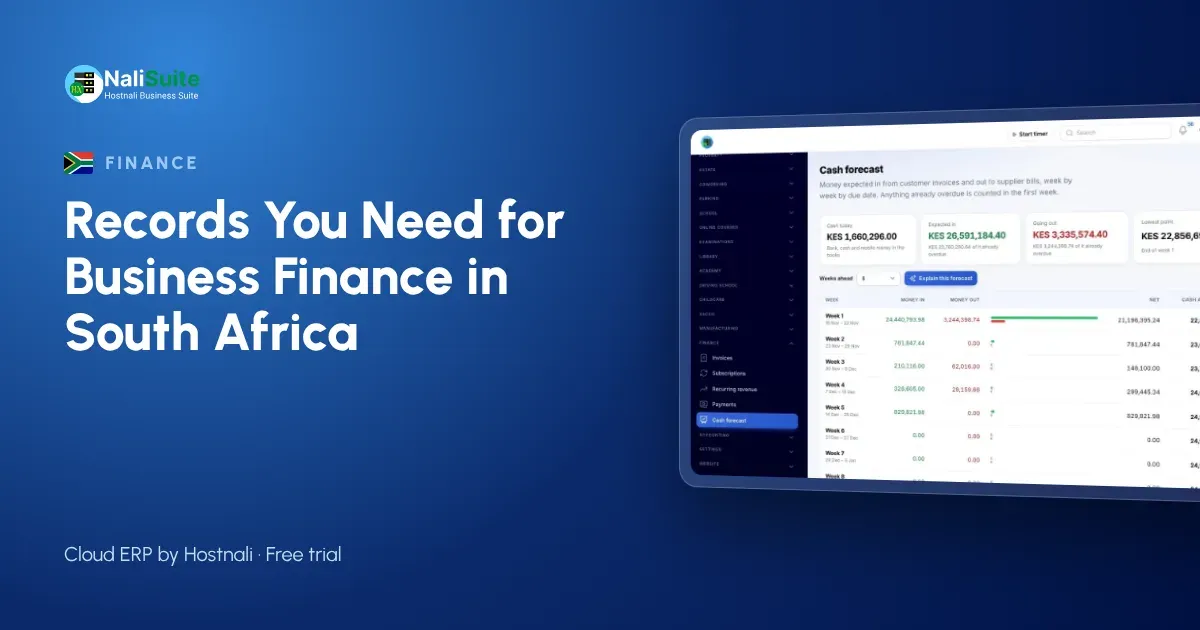
- Cash flow forecast for at least the term of the finance, showing how instalments are met. Our cash flow guide for South African businesses explains how to build one.
- Supporting contracts, such as a signed tender award or a framework agreement with a key customer.
Section G: Security
Some finance is secured: asset finance on the asset itself, others with suretyships, cessions of debtors or other security. Have asset registers, vehicle registration papers and any existing security agreements ready.
A worked example: Lerato’s facilities company
Lerato runs a cleaning and facilities company in Durban with contracts at three office parks. She has won a contract at a hospital that requires new equipment and more staff before the first invoice is paid.
Her pack:
| Section | What she included |
|---|---|
| A | CIPC documents, IDs, company profile with client list |
| B | TCS PIN, VAT201s, UIF registration, payroll reports |
| C | Two years of financial statements, year-to-date management accounts, budget |
| D | Twelve months of business bank statements |
| E | Debtors age analysis showing her office-park clients pay within terms; vehicle finance schedule |
| F | Hospital contract, equipment quotations, cash flow forecast for the first year |
| G | Equipment to be financed as security |
Because the pack was complete, the lender’s questions focused on the new contract rather than on missing paperwork.
Keeping the pack current
The fastest way to build a funding pack is never to let it go out of date. NaliSuite Accounting records every invoice, supplier bill and payslip as it happens, so management accounts, the balance sheet and the cash flow statement are always ready, with budgets for comparison. Invoicing produces the debtors age analysis, payroll keeps PAYE and UIF records, bank reconciliation shows the books agree with your statements, and Documents keeps CIPC papers, contracts and certificates in one place to share securely.
Frequently asked questions
What is a tax compliance status PIN?
A PIN you generate on SARS eFiling that lets a third party, such as a lender, verify your tax compliance status.
Do I need audited financial statements?
It depends on your company’s requirements and the lender. Many lenders accept reviewed or compiled statements for smaller amounts.
How many months of bank statements are needed?
Six to twelve months is common; ask each lender.
Will a complete pack guarantee approval?
No, but it makes your application faster and easier to assess.
Try NaliSuite
Keep your funding pack up to date every month. NaliSuite starts at R 38 a month with a free trial. See the plans.