 ZAR
 KES - Kenya
 UGX - Uganda
 TZS - Tanzania
 RWF - Rwanda
 NGN - Nigeria
 USD - Zimbabwe
 GHS - Ghana
 ETB - Ethiopia
 ZMW - Zambia
 USD - International

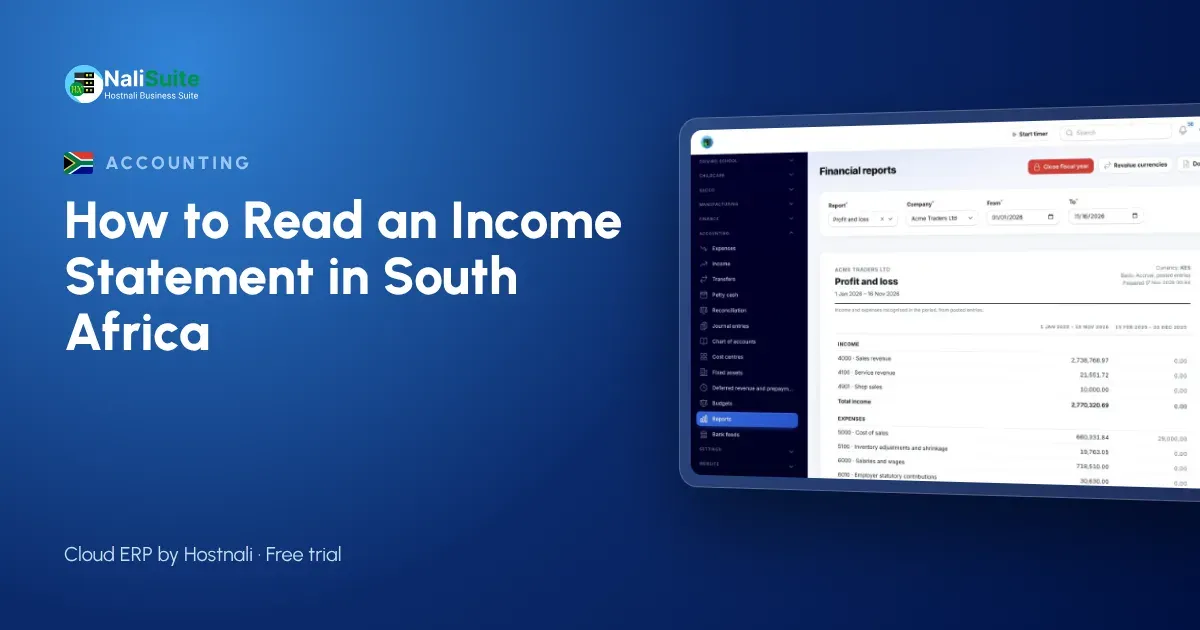
In South Africa you will hear it called the income statement, the statement of profit or loss, or simply “the P&L”. Whatever the name, it is the report your accountant or bookkeeper prepares for your annual financial statements and the basis of the income tax return you submit to SARS. Many owners only see it once a year, at the point where it is too late to change anything.
This guide explains how the income statement fits next to your other two key reports, how to read the margins in it and which actions follow.
Three reports, three different questions
Before reading the income statement, it helps to know what it is not.
| Report | Question it answers | Covers |
|---|---|---|
| Income statement (P&L) | Did we earn more than we spent to earn it? | A period, such as March |
| Balance sheet | What do we own and owe right now? | A single date, such as 31 March |
| Cash flow statement | Where did the cash come from and go? | A period |
A guesthouse owner in Knysna can have a profitable summer on the income statement and still run short of cash in winter, because the bond repayment, the new geyser and the deposit paid back to a cancelled group do not appear as expenses. That is why the three reports are read together, and why we wrote a separate guide on cash flow for small businesses in South Africa.
The structure, in plain words
Revenue. Turnover for the period, excluding VAT if you are a VAT vendor. Output VAT is owed to SARS and never belongs in revenue.
Cost of sales. The direct cost of what you sold: stock, materials, and for some trades the direct labour that goes into each job.
Gross profit. Revenue less cost of sales.
Operating expenses. Salaries and wages, rent, electricity (and the diesel or gas that keeps you trading through load-shedding, if you still need it), insurance, telephone and data, card machine and bank fees, advertising, accounting fees.
Operating profit. Gross profit less operating expenses: the result of the trading itself.
Finance costs and tax. Interest on overdrafts, vehicle finance and loans, then the income tax charge. Your tax practitioner will work out the tax figure; check the current rules with SARS.
Net profit. What is left for the owners or shareholders.
Reading the margins
Rand figures are hard to compare from month to month. Percentages are easy. Work out three:
- Gross margin = gross profit ÷ revenue.
- Operating margin = operating profit ÷ revenue.
- Each major expense as a share of revenue, such as wages ÷ revenue.
A worked example
Thandi runs a small bakery in Pietermaritzburg supplying two coffee shops and a farm stall. Over three months she notices:
- Revenue up 8%, because she added a third coffee shop.
- Gross margin down from 52% to 46%. Flour, butter and electricity all rose and her prices to the coffee shops have not moved since the start of the year.
- Wages up as a share of revenue, because the new customer wants deliveries before 7am and she pays an extra driver for an early shift.
- Operating margin down by half.
The income statement shows the new customer is bringing revenue but taking more than its share of costs. Her options are clear: a price increase for wholesale customers, a minimum order size for early deliveries, or both.
Signs that the income statement is wrong
Before acting on the numbers, check they can be trusted:
- Revenue that does not match your bank and card machine settlements. Unrecorded cash sales or invoices captured twice both distort profit.
- Expenses with no supplier invoice. Missing source documents are a problem for SARS as well as for you.
- No stock count at period end. Cost of sales depends on opening and closing stock.
- Owner’s personal costs in the business. A family car or private medical aid paid by the business without a proper arrangement overstates expenses.
- VAT inside revenue or expenses. If you are a VAT vendor, income and costs should be shown excluding VAT.
What to do after reading it
- Re-price products or services where the gross margin has slipped.
- Review the three largest expenses every quarter and get a competing quote for at least one.
- Set a target operating margin and compare each month against it.
- If profit is good but cash is poor, look at debtors before applying for more credit.
Producing a reliable income statement every month
When your bookkeeping lives in spreadsheets, the income statement arrives months late. NaliSuite Accounting posts each invoice, supplier bill, card machine settlement and payslip to the ledger as it happens, so the income statement, balance sheet and cash flow statement are ready whenever you open them, with the prior period alongside for comparison. Bank reconciliation matches your statement lines to the books, and budgets and cost centres let you compare a branch, a delivery route or a product line against plan. If you take payments online, online payments post receipts straight to the right invoice.
Frequently asked questions
Is an income statement the same as a profit and loss statement?
Yes. Income statement, statement of profit or loss and P&L are names for the same report.
Do small companies in South Africa need annual financial statements?
Companies generally need annual financial statements; the exact requirements depend on the type and size of the entity. Ask your accountant which apply to you.
Should the income statement include VAT?
If you are a registered VAT vendor, revenue and expenses are shown excluding VAT. VAT owed to or by SARS sits on the balance sheet.
How often should I look at it?
Monthly for running the business, annually for the tax return and financial statements.
Try NaliSuite
Get a live income statement and balance sheet without spreadsheets. NaliSuite starts at R 38 a month with a free trial. View the plans.