 ZAR
 KES - Kenya
 UGX - Uganda
 TZS - Tanzania
 RWF - Rwanda
 NGN - Nigeria
 USD - Zimbabwe
 GHS - Ghana
 ETB - Ethiopia
 ZMW - Zambia
 USD - International

South African customers expect prices that already include VAT, SARS expects proper tax invoices, and your bank balance expects you to set aside the VAT you collect. Here’s how a small business in Johannesburg, Cape Town or Durban keeps all three happy.
Inclusive pricing is the norm
Retail prices in South Africa are shown including 15% VAT. That means the VAT is already inside every rand you take at the till. To see how much is VAT, divide by 1.15: a R1,150 sale contains R1,000 of revenue and R150 of VAT.
If you quote business customers before VAT, multiply by 1.15 instead. A R4,000 service invoice becomes R4,600. The VAT calculator switches between the two.
Tax invoices, not just receipts
SARS uses the term tax invoice, and your customers who are VAT vendors need one to claim input tax. Include:
- the words “tax invoice”, your business name, address and VAT number
- the customer’s details where required
- a serial number and the date
- a description of the goods or services
- the value, the VAT and the total, or a statement that VAT is included
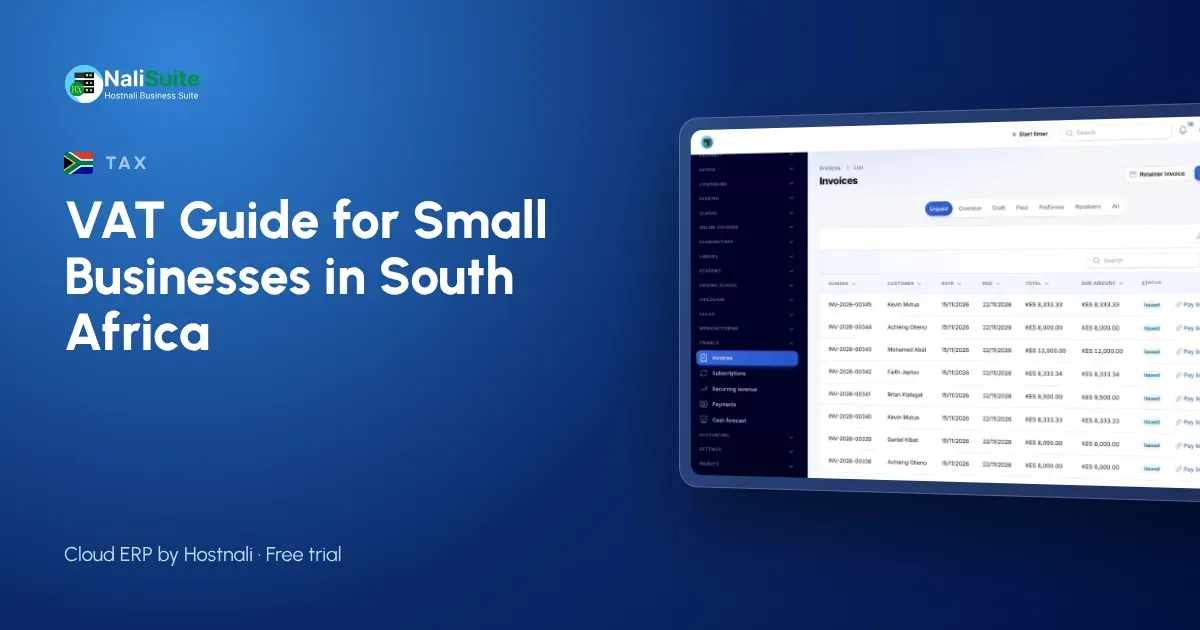
The exact requirements depend on the value of the sale, so check SARS guidance for the details that apply to you. NaliSuite Invoicing numbers invoices in sequence and shows VAT per line.
Input tax keeps your VAT bill down
VAT on stock, rent, software and other business costs can be claimed against the VAT you charge, if you hold valid tax invoices. Keep them filed by month. Snapping the invoice when you receive it beats searching your inbox later.
The VAT201 return
Most small vendors file a VAT201 on SARS eFiling for each tax period. Your figures come from your sales, your purchases and any adjustments. With sales and bills kept in NaliSuite Accounting, the VAT report gives you the numbers; you submit and pay on eFiling.
Keeping VAT money separate
Because the VAT is inside your takings, it’s easy to spend it. Many owners move the VAT portion to a separate account each week. Reconciling your bank weekly in NaliSuite makes that habit simple, and online payments post card and EFT receipts straight to the right invoice.
Cash basis or invoice basis
Some smaller vendors in South Africa account for VAT when payment is received rather than when the invoice is issued. Whether you can do this depends on your circumstances, so ask SARS or your tax practitioner. It matters: on the invoice basis you pay VAT on invoices your customers haven’t paid yet, which hurts cash flow when customers pay late.
A worked period for a Durban contractor
A sample electrical contractor in Durban issues invoices for installations and maintenance. During a two-month period it charges VAT on every invoice, buys cable, fittings and fuel with VAT included, and pays rent for a small yard. The VAT201 for the period shows output tax on the invoices, input tax on the purchases backed by valid tax invoices, and the balance due. Because the contractor keeps each supplier’s tax invoice photographed and filed against the bill in NaliSuite, nothing is lost when the return is prepared.
Load-shedding and records
Power cuts don’t stop the paperwork. A cloud system keeps your invoices and bills safe even when the office loses power, and the till keeps selling offline.
Second example: a mixed-supply invoice
A sample Gqeberha catering business supplies a corporate event: food, equipment hire and staff. If any part is zero-rated or exempt, that line needs its own treatment. Setting the tax per product in NaliSuite means one invoice can carry 15% on most lines and a different treatment where SARS rules require it.
Records SARS may ask for
Keep tax invoices, credit and debit notes, bank statements, import documents and your VAT201 workings together for each period. If SARS asks questions, being able to show the invoice behind a line on your return within minutes saves a great deal of back and forth. NaliSuite keeps each bill with its invoice image and each sale with its invoice, so the trail from return to document is short.
When to ask a tax practitioner
Check your settings with a tax practitioner when you register, when you start importing or exporting, and if SARS changes your tax period.
Frequently asked questions
What is the VAT rate in South Africa?
The standard rate used here is 15%. Some supplies are zero-rated or exempt.
Do I have to show VAT separately on every invoice?
Tax invoice requirements vary with the amount. Check SARS guidance for your situation.
Can NaliSuite file my VAT201?
NaliSuite prepares the figures. You file and pay on SARS eFiling.
How often do I file VAT201?
Most small vendors file every two months, but your tax period depends on your registration. Check with SARS.
Should quotations show VAT?
Yes. Showing VAT-inclusive totals on quotations avoids disputes later.
Try NaliSuite
Tax invoices with VAT per line, input tax tracked from your bills and a VAT report for each period, from R 38 a month. See plans.