 ZAR
 KES - Kenya
 UGX - Uganda
 TZS - Tanzania
 RWF - Rwanda
 NGN - Nigeria
 USD - Zimbabwe
 GHS - Ghana
 ETB - Ethiopia
 ZMW - Zambia
 USD - International

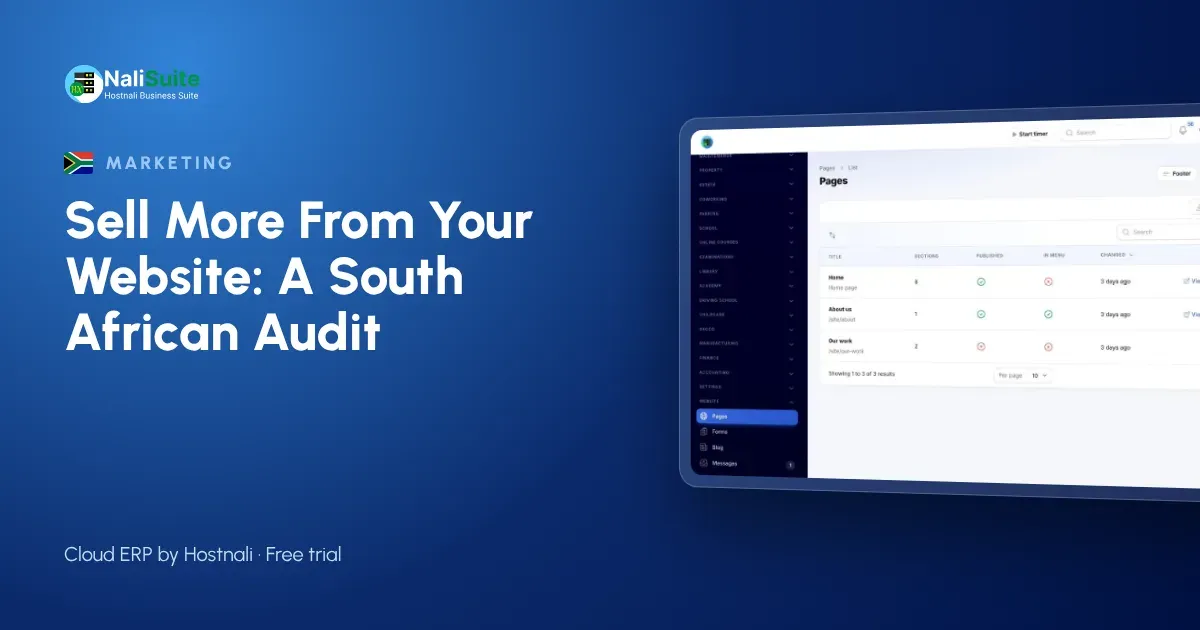
You do not need an agency report to find out why your website is not selling. A careful twenty minutes with a checklist will usually show you. The trick is to look at the site the way a stranger in Cape Town or Polokwane would: on a phone, in a hurry, with three competitors open in other tabs.
This article gives you a six-part audit with a simple score for each part. Add up your score, then fix the lowest-scoring areas first.
How to score
For each statement, give yourself:
- 2 points if it is fully true;
- 1 point if it is partly true;
- 0 points if it is not true.
Each part has four statements, so the maximum is 8 per part and 48 overall. Do the audit on your phone.
Part 1: clarity
- The first screen says what you sell, who it is for and where you operate.
- A visitor can reach your main products or services in one tap.
- Each main product or service has its own page.
- There is one obvious next step on every page (buy, book, ask for a quote).
If you scored low: rewrite your homepage headline. “Solar installations for homes and small businesses in Gauteng” tells visitors more than “Powering your future”. Then give each main service its own page with its own call to action.
Part 2: prices and information
- Prices, or “from” prices, are shown for your main products or services.
- Product pages include sizes, specifications and what is included.
- Delivery areas, delivery times and costs are explained.
- Returns, refunds and guarantees are easy to find.
If you scored low: South African shoppers compare before they commit. Even “packages from…” keeps more visitors than “contact us for pricing”. Put delivery and returns information where people look for it, on product pages and at checkout.
Part 3: trust
- Your physical address, phone number and email on your own domain are visible.
- There are photos of real work, products, premises or people.
- Customer reviews appear, used with permission.
- The site uses HTTPS and looks current, with no out-of-date offers.
If you scored low: add your location and a map, a few real photos and reviews. Use an email address on your domain, and make sure the site has a valid SSL certificate; Hostnali’s hosting plans include free SSL.
Part 4: speed and mobile
- Pages load quickly on mobile data.
- Text is readable without zooming and buttons are easy to tap.
- Images are compressed and there are no autoplay videos.
- Forms work properly on a phone.
If you scored low: compress images and remove heavy extras. Hosting matters too: Hostnali’s web hosting uses NVMe storage and LiteSpeed for quicker loading.
Part 5: buying and asking
- Customers can buy online, or there is a clear quote or booking route.
- The checkout or enquiry form asks only for what you need.
- Customers can pay by card or instant EFT, or are told clearly how to pay.
- Enquiries reach a system where someone is responsible for replying.
If you scored low: if you sell products, a short checkout is essential. Hostnali’s AI website builder creates a website from a description of your business, including online shop designs with cart, checkout, delivery options and card or cash-on-delivery payment to your own accounts.
If you sell by quotation, speed of reply is everything. In the NaliSuite website app, form submissions become leads in the CRM. The sales app then builds a quotation the customer can accept online, which becomes an order and invoice without retyping.
Part 6: follow-up
- Visitors can subscribe to hear from you.
- New subscribers receive a welcome email or sequence.
- Quotations that were not accepted are followed up.
- Customers who bought are asked for a review and invited back.
If you scored low: add a subscribe form with a real reason to join, and set up a short welcome sequence. The NaliSuite marketing app handles lists, campaigns and automatic follow-ups for people who opted in, within POPIA’s rules on direct marketing.
Reading your score
| Total | What it means |
|---|---|
| 40–48 | Your website is working hard. Fine-tune and measure. |
| 28–39 | Solid base with clear gaps. Fix the lowest part first. |
| 16–27 | The site is losing sales at several stages. Plan a focused rework. |
| 0–15 | Consider rebuilding rather than patching. |
Fix in this order
If several parts scored low, this order usually brings the quickest results:
- Clarity, because everything else depends on visitors understanding you.
- Buying and asking, because it is where money changes hands.
- Prices and information.
- Trust.
- Speed and mobile.
- Follow-up.
Rebuild or repair?
If your current site cannot take payments, is slow or is hard to update, a rebuild is often faster. Build it yourself with the AI website builder, or let our team build it through Hostnali’s web design service. If your score was respectable, repair it part by part and audit again in three months.
Frequently asked questions
How often should I audit my website?
Every three to six months, and after any big change to your products or prices.
Is an online shop essential?
No. Businesses that sell by quotation or booking need fast, tracked replies more than a cart.
Can website enquiries go straight into a CRM?
Yes. In NaliSuite, website form submissions become leads or tickets.
How much is NaliSuite?
Plans start at R 38 a month, with the website, CRM, sales and marketing apps on every plan.
Try NaliSuite
Fix your lowest-scoring areas with a website that feeds leads, quotations and orders into one system. See the NaliSuite plans and start a free trial.