 ZAR
 KES - Kenya
 UGX - Uganda
 TZS - Tanzania
 RWF - Rwanda
 NGN - Nigeria
 USD - Zimbabwe
 GHS - Ghana
 ETB - Ethiopia
 ZMW - Zambia
 USD - International

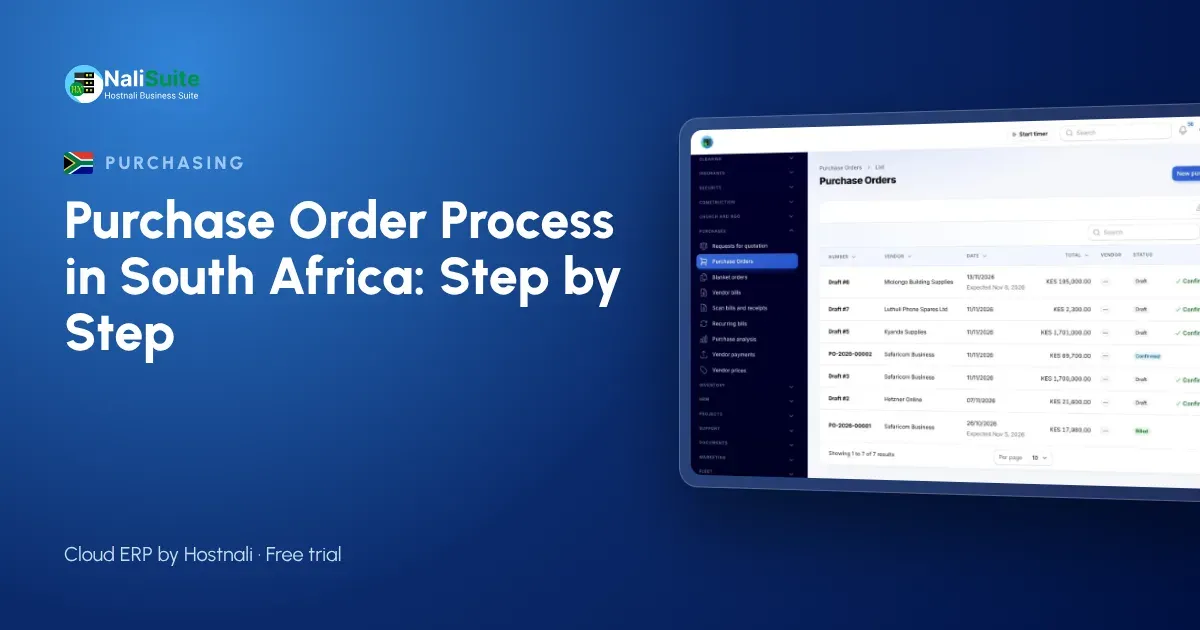
A catering company in Durban or a building supplier in Pretoria buys something almost every day. Without a clear purchase order process, those small purchases add up to duplicated orders, missing deliveries and supplier statements nobody can reconcile.
Here is a simple process that works for South African small businesses, from the first request to paying the supplier by EFT.
Why buying needs a process
Without purchase orders, three things go wrong again and again: people order things nobody approved, deliveries arrive short or damaged and nobody notices, and bills are paid without checking what was ordered. Each mistake is small. Together they eat the margin.
The purchase order process, step by step
1. Raise a request
Staff raise a request in the system instead of phoning a supplier. It records the item, quantity and the job or branch it is for.
2. Approve within a limit
The request goes to whoever can approve that amount. Approval is a tap on a phone, so it does not slow the work down.
3. Send the purchase order
The approved request becomes a purchase order with the agreed price, quantity, delivery date and address, sent to the supplier by email or WhatsApp.
4. Record what arrived
The storekeeper or site manager records the quantities that actually came, which may differ from what was ordered.
5. Match the bill and pay
The supplier’s bill is matched to the PO and the delivery. Only matched bills are paid, and the payment is recorded against the bill.
Three-way matching
The single most useful habit in purchasing is to compare three things before any money leaves the account:
| Check | Compare | Look for |
|---|---|---|
| Quantity | PO against delivery | Short or extra items |
| Price | PO against bill | Prices above the agreed rate |
| Total | Delivery against bill | Charges for goods that never came |
If all three agree, pay. If they don’t, ask the supplier before paying. Most differences are honest mistakes, but they only get fixed if someone looks.
Example: a catering company in Durban
Consider an example catering company in Durban that buys meat, vegetables and packaging for weddings and corporate lunches. Chefs used to phone suppliers directly, so the owner only saw what had been ordered when the statements came in at month end.
Now each chef raises a purchase request for an event, the owner approves anything above the agreed limit, and suppliers receive a PO with the event date and delivery address. When the van arrives, the kitchen checks quantity and quality against the PO and rejects what is spoiled. The bill is matched to the PO and the delivery before it is paid by EFT.
Tax invoices and VAT in South Africa
VAT in South Africa is charged at 15%. When your supplier is VAT-registered, keep their tax invoice with the bill: it is the document that supports the VAT you claim back on your return, so check the supplier’s VAT number, the amounts and the description when you match it.
A purchase order process makes this easier because every bill already has a PO and a delivery behind it. When SARS asks questions, you can show what was ordered, what arrived and what was paid.
Common mistakes to avoid
- Letting the driver sign for everything. Whoever receives goods should count them against the PO.
- Changing prices by phone. If a price changes, change the PO, so the bill can be matched.
- Keeping bills in a drawer. Record each bill as it arrives, so you know what you owe and when.
- Skipping small orders. Small orders add up. Keep the process quick enough that nobody wants to skip it.
Supplier terms and month-end in South Africa
Many South African suppliers work on 30-day terms from statement. That makes it tempting to pay whatever the statement says. Instead, compare the statement with your matched bills and pay only what you have matched, so short deliveries and credit notes are not forgotten.
Record each EFT against the bill it pays and use the bill number as the payment reference. At month end, reconcile your bank statement so every supplier payment has a bill and a PO behind it. Bank reconciliation in NaliSuite suggests the matches for you.
If you run more than one site, raise POs per site so each kitchen, store or branch sees its own spending.
Doing it in software
When the process lives in software, nothing depends on paper or memory. NaliSuite Purchases handles requests, approvals and POs; receiving updates inventory; and bills flow into accounting ready for payment.
Frequently asked questions
Why do I need the supplier’s tax invoice?
It supports the VAT you claim on your return. Check the supplier’s VAT number and the VAT amount on it, and keep it with the matched bill.
How should I pay suppliers?
Most South African suppliers are paid by EFT. Pay only bills that match a PO and a delivery, and record each payment against the bill.
Who should approve purchase orders?
Usually a department head or manager for everyday purchases, and the owner for large or unusual ones. Set the limits in your system.
Can suppliers see our purchase orders?
They receive each PO by email or WhatsApp and should quote its number on their delivery note and bill.
Try NaliSuite
Try NaliSuite free: purchase orders, stock and supplier bills in one place, from R 38 a month. Compare the plans.