 ZAR
 KES - Kenya
 UGX - Uganda
 TZS - Tanzania
 RWF - Rwanda
 NGN - Nigeria
 USD - Zimbabwe
 GHS - Ghana
 ETB - Ethiopia
 ZMW - Zambia
 USD - International

Every rand your business spends tells a story: what it costs to deliver your product, where money is being wasted, and what you may be able to claim back as input VAT or deduct for income tax. But that story only exists if the expense is recorded. Many small businesses in South Africa lose track of a surprising share of their spending, and pay for it in missed claims, messy year ends and decisions made in the dark.
This guide follows an expense from the moment money leaves the business to the moment it appears, reconciled, in your books.
Before the spend: set the rules
Good tracking starts before anyone spends anything. Decide:
- Who may spend, and up to what amount, without asking first.
- How they pay: business card, EFT from the business account, or petty cash. Never a personal card unless it is a claim.
- What they must bring back: a valid tax invoice or receipt for every payment.
Write it on one page and share it with every person who buys anything for the business.
At the spend: get the right document
If you are a VAT vendor, you can generally only claim input VAT when you hold a valid tax invoice from a VAT-registered supplier. A till slip without the supplier’s VAT number may not be enough. SARS sets out what a tax invoice must show, so check the current requirements with SARS or your accountant, and ask suppliers for a full tax invoice for larger purchases.
For every expense, the minimum record is:
- date,
- supplier,
- amount, and VAT if shown,
- what it was for,
- who spent it.
Straight after: capture it
The longer a receipt sits in a wallet or a car’s cubbyhole, the less likely it is to reach the books. Ask staff to photograph receipts on the day and submit them. With NaliSuite’s employee self-service, staff snap the receipt, submit the claim from their phone and follow it through approval to payment.
For supplier invoices arriving by email, the Document AI add-on reads PDFs and photos – supplier, invoice number, dates, lines, VAT and totals – so you only check and save them instead of typing. It uses your own Anthropic API key.
In the books: categorise consistently
Use a short, stable list of expense categories that your accountant maps to the chart of accounts:
| Category | Typical items |
|---|---|
| Cost of sales | Stock, materials, subcontractors |
| Premises | Rent, levies, repairs, security |
| Utilities and power | Electricity, water, generator diesel, inverter maintenance |
| Vehicles and travel | Fuel, tolls, e-tolls, maintenance, flights |
| Staff | Salaries, UIF, training, staff welfare |
| Marketing | Online ads, printing, events |
| IT and communication | Software, data, phones, hosting |
| Professional fees | Accounting, legal, consulting |
| Bank charges | Account fees, card machine fees |
Load-shedding costs deserve their own visibility. Diesel, inverter batteries and generator services can be a large, growing cost that hides inside “repairs” or “sundries”.
Approval: one more check before money leaves
For bigger spending, approval before payment prevents most problems. In NaliSuite purchases, you can set approval rules by amount for purchase orders, bills and expenses. Supplier bills are checked against the order and the goods received – three-way matching – before they are paid.
Month end: reconcile
Reconciliation proves your records are complete. Go through the bank statement line by line and make sure each payment has a matching, categorised expense with a document attached. Then check that every recorded expense actually appears on the statement or in petty cash.
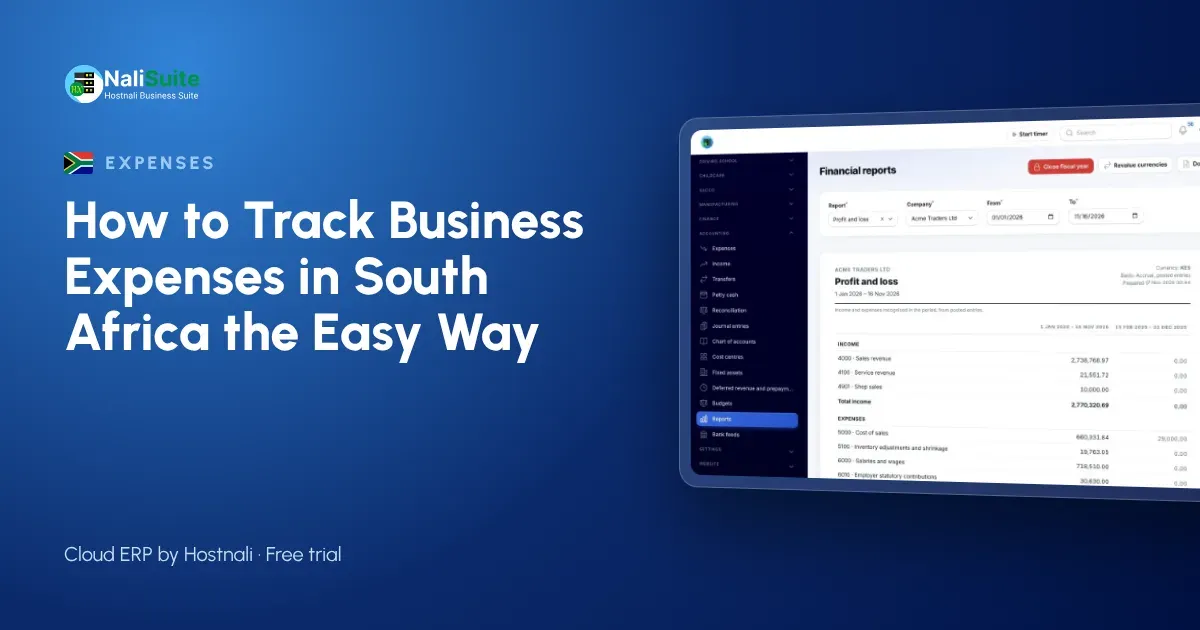
NaliSuite accounting imports statements or connects bank feeds and suggests matches, and bank reconciliation lists anything still unmatched. Most months, the job takes minutes instead of a day.
Petty cash: small but risky
Cash is the hardest expense to track. Keep a fixed float, issue cash only against a signed voucher with a receipt, and top up the float only for the total of vouchers presented. Count it at every top-up.
What good tracking gives you
Take a sample events company in Pretoria. Once every expense was captured and categorised, the owner saw that vehicle hire for small events was costing more than leasing a bakkie would. The decision was obvious once the number was visible. That is the point of tracking: not paperwork, but better decisions and fewer surprises at tax time.
Separate business and personal spending
For sole proprietors and small companies alike, mixing personal and business spending on one card or account is the fastest way to lose control. Keep a dedicated business account and card, pay yourself a salary or drawings from it, and treat any business cost you pay personally as a claim with a receipt. Your accountant will thank you, and your year-end bill may be smaller.
Frequently asked questions
Can I claim VAT on every business expense?
Not always. Some expenses do not qualify, and you need a valid tax invoice. Check with SARS or your accountant.
Should staff use their own cards?
Preferably not. If they do, treat it as an expense claim with a receipt and approval, and reimburse promptly.
How often should I reconcile?
At least monthly. Weekly is better if you have many transactions.
Try NaliSuite
NaliSuite brings expense claims, supplier bills, approvals and bank reconciliation together. Plans start at R 38 a month, shown in rand, with a free trial. View the plans.