 ZAR
 KES - Kenya
 UGX - Uganda
 TZS - Tanzania
 RWF - Rwanda
 NGN - Nigeria
 USD - Zimbabwe
 GHS - Ghana
 ETB - Ethiopia
 ZMW - Zambia
 USD - International

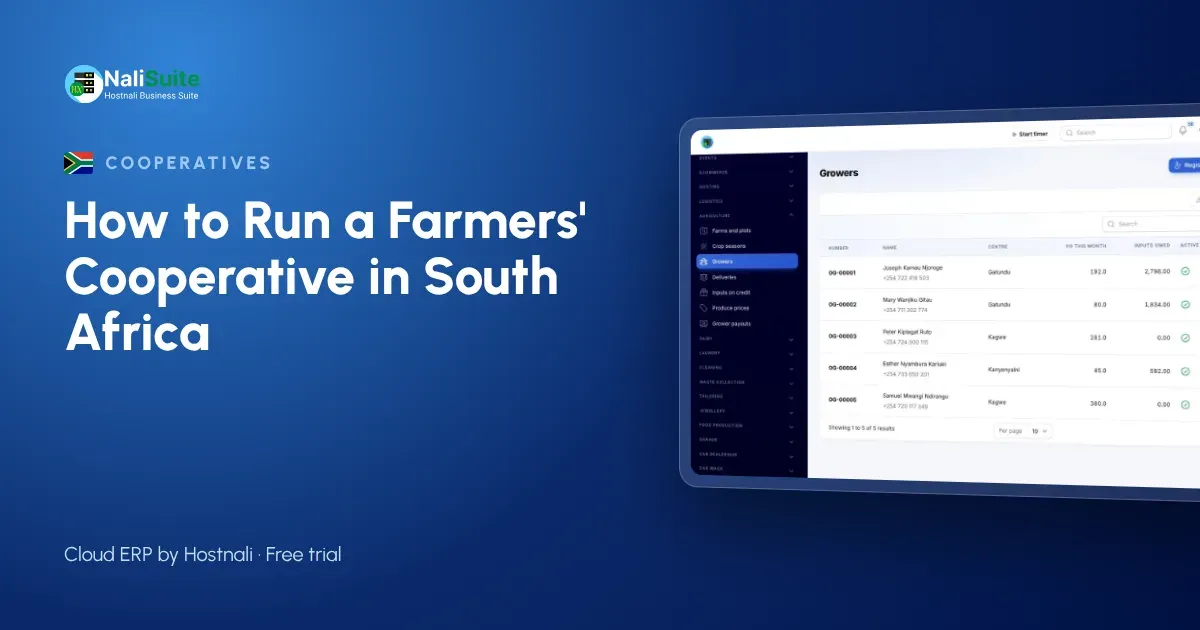
South African farmers’ cooperatives range from small vegetable groups supplying a local market to grain and dairy cooperatives handling serious volumes. Whatever the size, the same jobs repeat every season: keep members on record, weigh what they deliver, recover what they owe and pay them by EFT with a statement that adds up. Here is how to run those jobs without drowning in spreadsheets.
Start with a clean member register
Everything else depends on the register. Give every member a number, and record their name, phone, payment details, the route or collection centre they use and the date they joined. Add next of kin, because a member’s family will need to be paid if the member dies or falls ill.
Review the register once a season. Mark members who have stopped delivering as inactive rather than deleting them, so their history and any balance they still owe stay on record.
A worked example: a vegetable cooperative in Limpopo
Take a vegetable cooperative in Limpopo with forty emerging farmers who supply tomatoes, butternut and cabbage to a fresh produce market and two retail buyers. Crates are weighed and graded at the packhouse, and each buyer pays a different price. The treasurer used to rebuild the whole season in a spreadsheet before every payout. Once each delivery was weighed, graded and recorded against the farmer, and buyer payments were matched to deliveries, the monthly EFT run became a check rather than a project.
Make the collection point the source of truth
The collection point is where errors either start or stop. Capture each intake as it happens, with the member number, quantity, grade and the price that applies on that day, and give the member a receipt by text.
For milk, record morning and evening intake separately and reject deliveries that fail the quality check at the door, rather than arguing about them at month end.
Track what members owe before payday
Credit is where cooperatives lose money quietly. Every bag of fertiliser, sack of feed or cash advance given to a member should be recorded against them as it leaves the store, not reconstructed from memory at the end of the season.
Set a limit on credit per member, linked to what they usually deliver, so nobody falls so far behind that their payout disappears entirely.
Paying members by EFT
Members in South Africa expect to be paid by EFT. Capture banking details when a member joins, verify them, and treat any request to change them with suspicion until it is confirmed in person or by phone, because changed banking details are a common route for fraud.
Remember that the cooperative holds personal information about every member, from ID numbers to bank accounts. Under POPIA, overseen by the Information Regulator, that information has to be kept secure and used only for the purpose it was collected for, so limit who can see member records.
Agree the deductions and show every one
Before the season starts, agree in writing which deductions apply: store credit, advances, a levy, share capital, savings contributions or loan repayments. Then show each one separately on the statement, never as a single lump.
A member who can see ‘feeds’, ‘share capital’ and ‘loan repayment’ as three lines understands where their money went. A member who sees one unexplained deduction assumes the worst.
Running the payout
A good payout takes hours, not days. Earnings from deliveries, minus each member’s deductions, give the amount due. The committee reviews and approves the list, and members are paid by bank transfer.
Record every payment as it goes out and reconcile the account afterwards, so any failed payment is spotted and resent the same week.
Statements and transparency
Send every member a statement each period: deliveries with dates and weights, the price applied, each deduction and the amount paid. Share it by text or WhatsApp, or let members log in to see it.
At the annual general meeting, show the totals: volume collected, what buyers paid, what was paid to members and what the cooperative kept. Openness is the best defence against rumours.
Putting it into practice with NaliSuite
The routine above maps directly onto NaliSuite. Deliveries, store credit and payouts for dairy groups run in the Dairy Cooperative Milk Collection add-on; crop collections, input credit and grower payouts in the Agriculture and Outgrowers add-on; savings and loans in the SACCO and Microfinance add-on.
All three share the same member records and post to the same Accounting books, and payouts go out through your bank or payment provider. The farms and cooperatives overview lists every app a cooperative typically uses.
Because you hold members’ phone numbers, IDs and payment details, follow POPIA, overseen by the Information Regulator, and decide who in the cooperative may see or change them.
Frequently asked questions
Can members see their own statements?
Yes. Members can receive their statement by email or WhatsApp, or log in to a member portal to see deliveries, deductions and payouts for each period.
Does this replace our auditor?
No. The software keeps clean records that make the audit faster, but the cooperative still needs its auditor and must meet its own reporting obligations.
Do the add-ons cost extra?
Yes. The cooperative add-ons are added to any NaliSuite plan and billed with the subscription; plans start from R 38 a month.
Can we import our existing member list?
Yes. A member list kept in Excel can be imported in one go, with names, phones and payout details, so you do not retype anyone.
Try NaliSuite
Pick one route or collection centre, set it up during a free trial and run it alongside your current books for a month. View plans and prices.