 ZAR
 KES - Kenya
 UGX - Uganda
 TZS - Tanzania
 RWF - Rwanda
 NGN - Nigeria
 USD - Zimbabwe
 GHS - Ghana
 ETB - Ethiopia
 ZMW - Zambia
 USD - International

Every South African business owner knows the moment: the bank balance looks healthy, yet three customers insist they have paid and your records say otherwise. Payment reconciliation is how you settle those arguments with evidence instead of memory.
What you are actually checking
Reconciling means proving that every amount on your bank and card statements is recorded once, against the right customer, supplier or expense. Done properly it answers three questions: who still owes you, what you still owe, and whether your profit figures can be trusted when the VAT201 return or the year-end comes round.
Before you start: get the statements in the right shape
Export statements from online banking as CSV rather than PDF. If you take card payments through providers such as PayFast, Ozow or Yoco, download their payout reports too. A single payout often combines a day’s card sales, less fees, so you need the report to see what it contains.
Matching, in order of difficulty
- EFTs with your invoice number in the reference. Mark these paid straight away.
- EFTs without a reference. Search open invoices by amount and customer name; confirm by email if two invoices share the same amount.
- Card payouts. Split each payout into the sales it covers and post the provider’s fee.
- Debit orders and supplier payments. Match them to supplier bills so your creditors’ list stays right.
- Bank fees and interest. Post them as expenses or income.
- Inter-account transfers. Record them as transfers between your own accounts.
When you are done, the book balance and the statement balance should be identical.
Signs your reconciliation is slipping
- Customer statements regularly show invoices that customers swear they settled.
- Your VAT on sales does not tie back to the payments you actually received.
- Small differences are being written off every month “to make it balance”.
- Nobody can explain a deposit from three months ago.
Each of these points to a routine that runs too rarely. A weekly half hour is usually enough to prevent all four.
Doing it in software
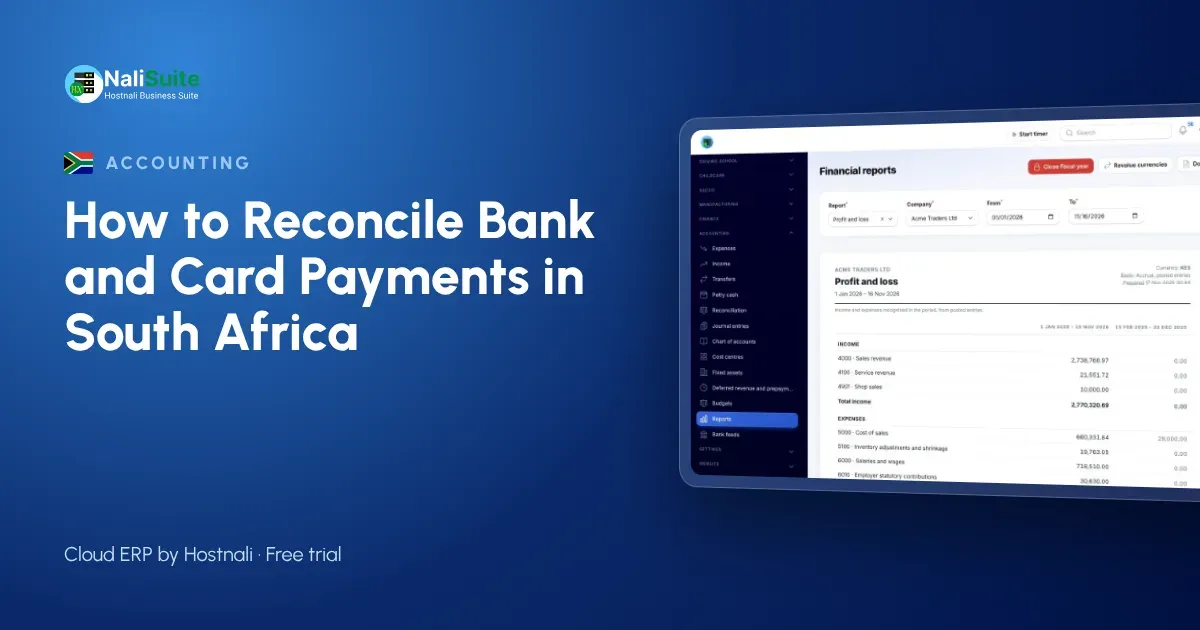
NaliSuite Accounting imports bank statements and proposes a match for every line, based on amount, date and reference. The Bank Feeds add-on pulls transactions in daily, and invoices paid through online payment links mark themselves paid before you even open the statement. The bank reconciliation feature explains the matching in more detail.
Reconciling after a load-shedding week
When power cuts close the shop early or knock the card machine offline, sales get recorded late, cash is counted in a hurry and the bank shows payouts on unusual days. That is precisely the week to reconcile carefully. Compare each day’s recorded sales with the card provider’s payout report, check that every cash-up was deposited, and look for sales that were rung up twice when the system came back. A till that keeps selling offline and syncs later, such as NaliSuite’s offline POS, reduces the mess, but the weekly check is still what proves the numbers.
A second example: a Pretoria guest house
A guest house in Pretoria takes deposits by EFT when a booking is made, the balance by card at check-out, and a few corporate bookings on account. The owner reconciles every Monday. Deposits are matched to bookings using the booking number in the EFT reference. Card payouts are split into individual guest bills and fees. Corporate payments, which sometimes cover several stays, are split across the right invoices using the remittance advice the company sends. Anything left over goes on a short list: a guest who paid twice, or a deposit for a booking that was later cancelled and needs refunding.
Common mistakes in South African small businesses
- Netting card payouts. Recording only the amount that reached the bank hides the fees and makes sales look smaller than they were.
- VAT on the wrong date. Reconcile before you prepare the VAT201, so the sales and payments it reports are complete.
- Ignoring old unpresented items. Old cheques or unclaimed refunds should be investigated, not carried forward for years.
- Mixing personal and business payments. A director’s personal purchases paid from the business account must be recorded as such.
Frequently asked questions
How often should a small business in South Africa reconcile?
Weekly works well for most. Businesses with many card sales often check daily payouts.
What if one EFT covers several invoices?
Split the payment across the invoices it settles, so each one closes correctly.
Can my accountant work from the same records?
Yes. Invite them as a user and they review the reconciled books directly, instead of asking for spreadsheets.
Should I reconcile before preparing my VAT201?
Yes. Reconciling first makes sure the sales and payments behind the return are complete and recorded once.
How do I handle a guest who paid twice?
Record both receipts, then either refund one or keep it as credit on the guest’s account, and note which.
Try NaliSuite
Plans start from R 38 a month, with accounting and invoicing included. Compare the plans.