 ZAR
 KES - Kenya
 UGX - Uganda
 TZS - Tanzania
 RWF - Rwanda
 NGN - Nigeria
 USD - Zimbabwe
 GHS - Ghana
 ETB - Ethiopia
 ZMW - Zambia
 USD - International

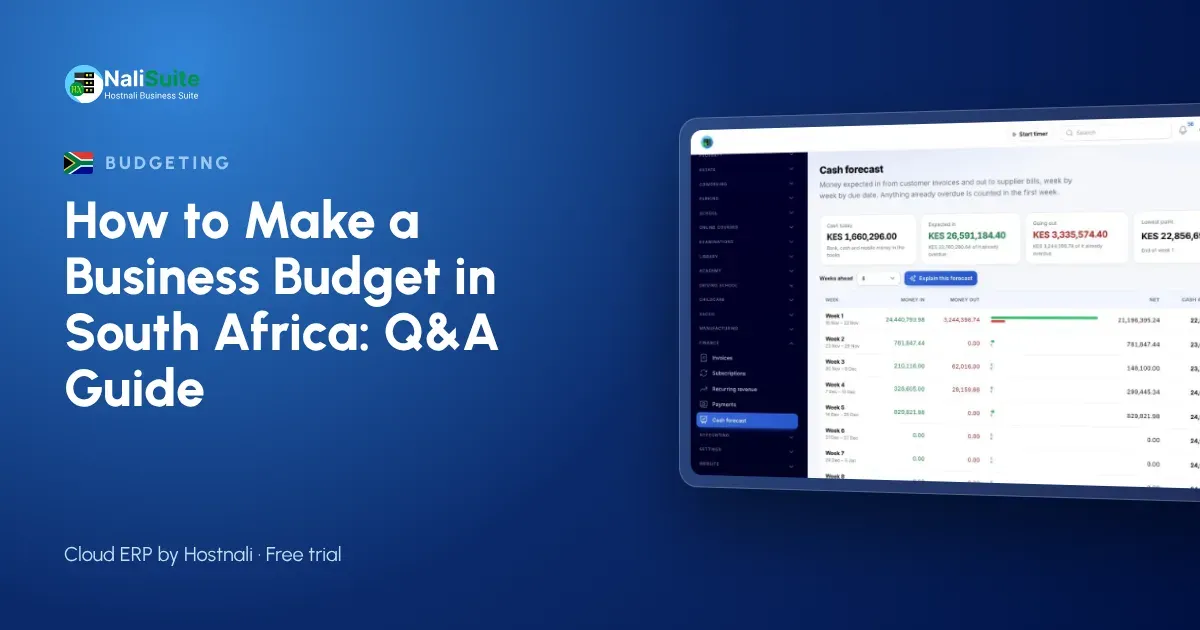
Small business owners in South Africa ask a lot of the same questions about budgeting: where to start, how detailed to be, what to do about VAT and payroll, and whether it is worth the effort at all. This guide answers those questions in order, so by the end you can build a working budget for the next twelve months.
Why bother with a budget at all?
Because a business can be profitable and still run out of money. A budget shows you, month by month, whether income will cover what you must pay – rent, salaries, SARS, suppliers – and when it will not. It also gives you a yardstick: when the month ends, you can see whether things went better or worse than planned and why.
There is a practical reason too. Banks, investors and larger customers increasingly ask for a forecast. Having one ready makes those conversations much easier.
What should a small business budget include?
At minimum:
- Sales, by month, ideally split by product line or customer type.
- Cost of sales: stock, materials and other costs that rise with sales.
- Operating expenses: rent, salaries, electricity, insurance, software, marketing, transport.
- Tax and statutory payments: VAT, PAYE, UIF, SDL where it applies, provisional tax.
- Capital spending: equipment, vehicles, shopfitting.
- The result: profit or loss for each month, and the cash position.
Ten to twenty lines will cover most businesses.
Where do the numbers come from?
From your own history first. Pull last year’s sales and expenses from your accounting records, bank statements and card machine reports. If you are new, use quotes from suppliers, the lease agreement, salary offers and realistic sales estimates based on how many customers you can serve.
How do I forecast sales honestly?
Work from things you can count. For a café in Cape Town, that might be customers per day × average spend × trading days. For a B2B service, it might be clients × monthly fee. Then adjust for the seasons that affect you:
| Season | Typical effect |
|---|---|
| December holidays | Busy for retail, tourism and hospitality; quiet for many B2B services |
| January | Slow for consumer spending after the festive season |
| Winter in the Western Cape | Fewer tourists in Cape Town; ski and Highveld businesses differ |
| Month end | Spending peaks around payday for consumer businesses |
If unsure, plan a little lower. Surprises on the upside are easier to handle.
How do I treat VAT in a budget?
If you are a registered vendor, VAT at 15% is collected on behalf of SARS. Do not count it as income. A simple approach is to budget all sales and costs excluding VAT for the profit view, and add a separate line in the cash view for the VAT you will pay to SARS each period. The VAT calculator helps split VAT-inclusive figures.
What about staff costs?
Budget the gross salary for each person, plus the employer’s UIF contribution of 1% (the employee pays 1% too, deducted from their salary), and the Skills Development Levy of 1% if your annual payroll is above R500,000. PAYE is deducted from employees’ pay and paid to SARS each month. The PAYE calculator shows what a salary costs and what the employee takes home. Check current tables with SARS.
What about load-shedding and other risks?
Include the costs you know: a generator or inverter, fuel, maintenance, and the effect of lost trading hours. Then add a contingency line for things you cannot predict, such as a few percent of operating costs.
How do I know if the budget is realistic?
Check three things:
- Fixed costs against your worst month. Could you pay them if sales came in at the low end?
- Margins against last year. If you have planned a much better margin, what has changed?
- Cash month by month. Customers who pay on 30- or 60-day terms push income into later months.
A sample month for a café
In plain example numbers, excluding VAT:
- Sales: 180,000.
- Food and drink costs (32%): 57,600.
- Salaries and contributions: 62,000.
- Rent: 28,000.
- Electricity, gas and backup power: 9,000.
- Card fees, software and other: 6,500.
- Marketing: 3,000.
- Planned profit before tax: 13,900.
In January, the owner plans sales 20% lower and keeps a reserve from December to cover the gap.
How often should I check it?
Monthly. Compare actual results with the budget, investigate the large differences and update the forecast for the rest of the year.
NaliSuite accounting lets you set budgets by account, department or project and compares them with actual figures at any time. Because invoices, bills, payments and payroll post themselves, there is no month-end retyping. Bank reconciliation keeps your actual figures matched to your statements.
Frequently asked questions
Is a cash flow forecast the same as a budget?
Not quite. The budget shows planned profit; the cash flow forecast shows when money actually moves. You need both, and they can sit on the same sheet.
Should I budget for provisional tax?
Yes, if you pay it. Put each payment in the month it is due and check amounts with your accountant or SARS.
What if I run several branches?
Budget each branch separately, then add them up. That shows which branch carries the others.
Try NaliSuite
NaliSuite keeps budgets, books, payroll and payments together, so you always know how the year is tracking. Plans start at R 38 a month, shown in rand, with a free trial. View the plans.