 ZAR
 KES - Kenya
 UGX - Uganda
 TZS - Tanzania
 RWF - Rwanda
 NGN - Nigeria
 USD - Zimbabwe
 GHS - Ghana
 ETB - Ethiopia
 ZMW - Zambia
 USD - International

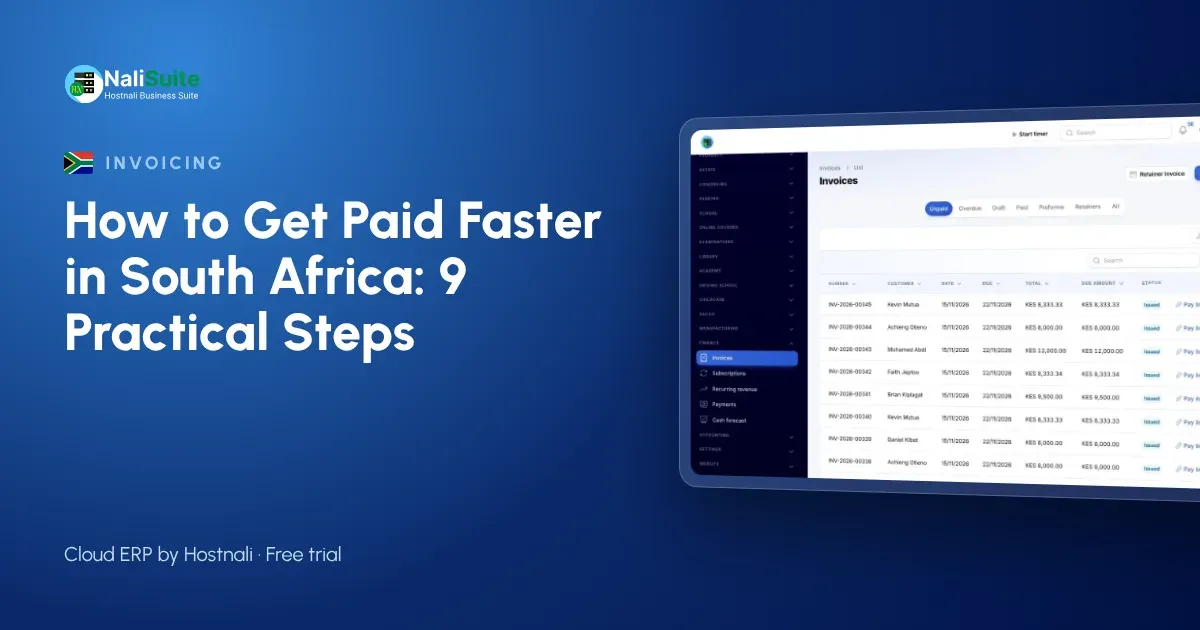
Most South African businesses do not have a sales problem, they have a collection problem. Work is done, invoices go out and then the waiting starts. Here is how an electrical contractor in Pretoria and a guest house in Cape Town cut that waiting, and how you can do the same with a few changes to how you invoice. The businesses in this guide are examples, but the problems will be familiar.
Send invoices nobody has to ask about
Accounts teams hold invoices they have questions about. When Thandi reviewed a month of late payments at the Pretoria contractor, half had a missing order number or an unclear amount. A clear invoice shows:
- your business name, phone and VAT number
- the customer’s name and their order or reference number
- an invoice number, the date and a due date in plain words
- each item with quantity, price and tax
- the total and the exact ways to pay
Need one quickly? The free invoice generator makes a PDF you can print or send. After the change, the Pretoria contractor stopped getting calls from builders and property developers asking what an invoice was for.
Invoice the day the work is done
At the Pretoria contractor, invoices used to be written up on Fridays from the delivery book, so some customers received them a week late and paid a week late. Now the invoice is raised when the goods leave. Nobody works harder; the clock simply starts sooner. If you deliver on Monday, the customer in South Africa should have the invoice on Monday. The Cape Town guest house follows the same rule for deposits: the request goes out the day a booking is confirmed, not at the end of the week.
Write the terms on the quotation
The Pretoria contractor lost several weeks a year to customers who “thought it was 60 days”. Now the quotation states the terms and the customer accepts it online, so the order and invoice carry the same terms with no retyping. Regular customers of the Cape Town guest house now see the same terms on every quotation, so there is nothing to renegotiate when the invoice arrives.
Make paying online the easy option in South Africa
Customers of the Pretoria contractor used to ask for bank details by phone before every payment. A pay link on the invoice ended that. Customers pay by card or bank transfer, and the invoice updates on its own. More on online payments. For the Pretoria contractor, the share of invoices paid within a week rose sharply once paying took a single step.
Let customers help themselves
A customer portal lets customers see and pay their invoices, download receipts and follow their orders without phoning you. For the Cape Town guest house, that removed most of the admin calls in busy weeks. Customers of the Cape Town guest house now check balances themselves before calling, which saves Thandi’s team hours each week.
Let reminders do the chasing
Calling customers about money is uncomfortable, so it gets put off. Automatic, polite reminders with the same pay link go out a few days before the due date, on the day and after it. Thandi at the Pretoria contractor says the after-due reminder alone brings in most late payments. The usual excuse at the Pretoria contractor, month-end payment runs at large clients, matters less when the reminder arrives with a link that takes ten seconds to use.
Match payments quickly
At the Cape Town guest house, payments sometimes arrive with no reference. Matching bank and card statements to invoices every few days, using reconciliation with suggested matches, keeps the overdue list accurate and the reminders polite. Matching every few days means Thandi never chases a customer of the Pretoria contractor who has already paid.
Getting paid faster in South Africa: local tips
In South Africa, business customers often run payments once or twice a month. Ask when their payment run is and set your due dates and reminders around it. A pay link that accepts card and instant EFT helps with smaller customers who pay as soon as they are asked.
Watch the total owed, not just single invoices
If the amount customers owe you keeps growing while sales stay flat, payment is slowing down. Thandi checks the total owed each week alongside sales, and the accounting reports make it a two-minute job. For the Pretoria contractor, the weekly check is now the moment to decide which of the builders and property developers get new deliveries.
Frequently asked questions
Which payment methods should I offer in South Africa?
Offer what your customers already use: card or bank transfer. The more familiar the option, the faster they pay.
Do pay links cost my customers anything?
That depends on your payment provider’s fees and how you set them up. The money goes to your own account, not through Hostnali.
When should I stop supplying a late payer?
Decide a rule in advance, such as pausing new orders when an account is a set number of days overdue, and apply it to everyone.
Can invoices go out automatically every month?
Yes. Subscriptions in NaliSuite raise and send recurring invoices with their pay link on the schedule you set.
Try NaliSuite
NaliSuite, also known as Hostnali Business Suite, handles invoices, payments and reminders for South African businesses, from R 38 a month with a free trial. Compare the plans.