 ZAR
 KES - Kenya
 UGX - Uganda
 TZS - Tanzania
 RWF - Rwanda
 NGN - Nigeria
 USD - Zimbabwe
 GHS - Ghana
 ETB - Ethiopia
 ZMW - Zambia
 USD - International

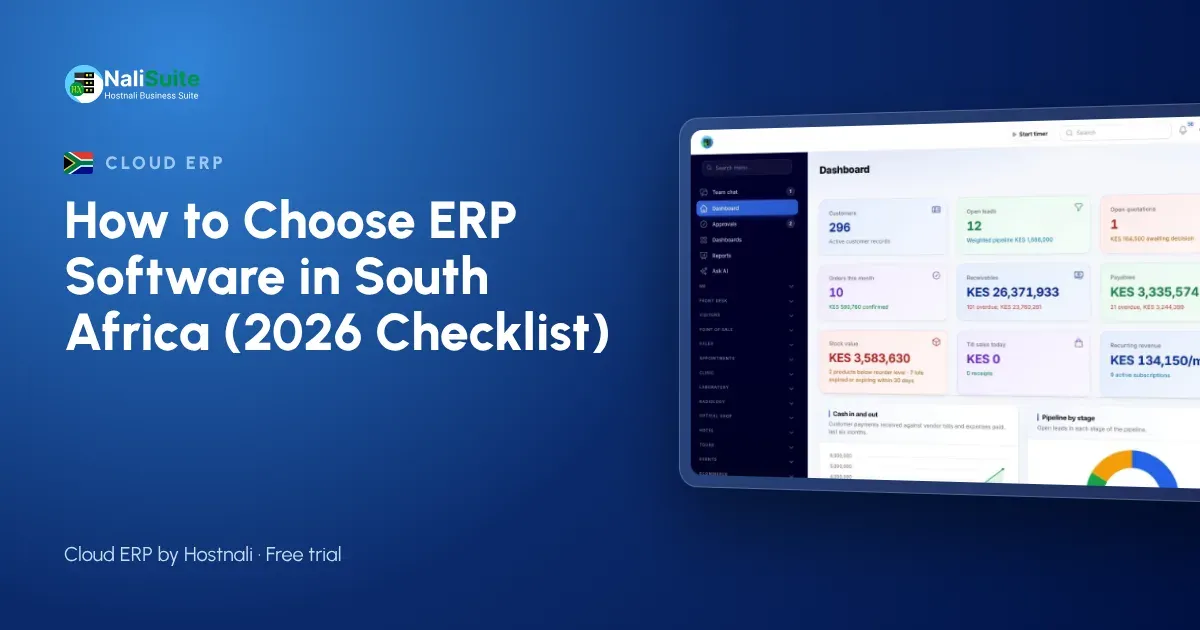
Plenty of South African small businesses run on accounting software for SARS, a separate till and a stock spreadsheet. The gaps between them are where time and money disappear, especially at month-end and at EMP201 time. This guide explains what to look for in ERP software in South Africa, using a franchise of hardware stores in Gauteng and KwaZulu-Natal as a running example. The companies named here are examples, but their situations are common.
What an ERP replaces
For most businesses in South Africa, an ERP replaces a mix of a till, an invoice template, a stock sheet, a payroll spreadsheet and a separate accounting package. Everything shares the same customers, products and staff, so reports agree with each other. For the hardware franchise, that meant one customer list instead of four.
It must handle how your customers pay
Customers in South Africa mostly pay by card or bank transfer. Your ERP should put a pay link on invoices through your own payment provider account and match payments to invoices without retyping. See online payments in NaliSuite. Thandi at the hardware franchise tested this first, before looking at any other feature.
It has to keep working when the internet does not
Connections drop. A point of sale that keeps selling offline and syncs later protects your takings, and managers should be able to check sales and stock from a phone. For the hardware franchise, a till that kept selling during an outage was worth more than any report.
Think about the second branch now
The hardware franchise chose its ERP with the next branch in mind. Stock per location, transfers and reports for each branch matter far more after you open it than before. NaliSuite covers several branches and companies. Thandi now sees each location of the hardware franchise on one screen instead of in separate files.
Tax and invoicing rules
Your ERP should work out VAT per line, show your VAT number on every invoice and give you the totals for returns to the South African Revenue Service (SARS). Rates change, so pick a system where you set and update the rates yourself. For quick checks, use the free VAT calculator. The hardware franchise checked how the tax settings work before importing a single product.
Ask these five questions
Before the hardware franchise signed up, Thandi asked every supplier the same questions: how payments are matched, how tax is handled in South Africa, what happens offline, how data is imported and whether there is a trial. Any vague answer was a warning sign. Suppliers who could not answer clearly were dropped from the hardware franchise’s shortlist.
Moving your data across
You do not start from zero. Customers, suppliers, products and opening balances can be imported from Excel or CSV. If you use QuickBooks, Xero, Sage or Tally today, see switching to NaliSuite. Running both systems side by side for a month is a safe way to switch. The hardware franchise moved its customer and product lists first and kept the old books for one more month.
A worked example: the hardware franchise
Take a franchise of hardware stores in Gauteng and KwaZulu-Natal. Before switching, Thandi kept sales in one file, stock in another and payroll in a third, and the figures for Johannesburg never agreed with the bank. The shortlist was simple: local payments, tax handled the way the South African Revenue Service (SARS) expects, and a till that keeps going when the network drops in Durban. After a month of running both systems, the hardware franchise moved fully across and closed its books in a day instead of a week.
Choosing an ERP in South Africa
South African businesses usually compare on SARS-ready VAT, payroll with PAYE, UIF and SDL, and how well the system copes with load-shedding. An offline till and cloud access from a phone matter more than they first appear.
Your checklist at a glance
| Question | Good answer |
|---|---|
| How do customers pay? | card or bank transfer, matched to invoices |
| Who sets tax rates? | you, in settings |
| Internet down? | the till keeps selling |
| More staff? | add users as you grow |
| Moving data? | import from Excel or CSV |
The hardware franchise used a list like this to compare three options side by side.
Frequently asked questions
What should a South African business check first?
Local payments (card or bank transfer), tax handling and payroll. Without those, the rest does not matter.
Can I keep using Excel for some things?
Yes, especially during the switch. Import and export to Excel or CSV is normal.
Do I have to use every app?
No. Switch on the apps you need and leave the rest off until you are ready.
Who helps with setup?
Our team can help with the first import and the basic set-up.
Try NaliSuite
See whether NaliSuite fits South African businesses like yours: look through the 17 built-in apps, pick a plan from R 38 a month and test it with your own data.