 ZAR
 KES - Kenya
 UGX - Uganda
 TZS - Tanzania
 RWF - Rwanda
 NGN - Nigeria
 USD - Zimbabwe
 GHS - Ghana
 ETB - Ethiopia
 ZMW - Zambia
 USD - International

South African customers have plenty of choice, and a slow or confused reply is often all it takes to lose them. For a service business, the support desk is where reputation is built: the way you handle a broken geyser or a faulty fridge says more than any advert.
This guide works through the questions owners usually ask before moving to a ticketing system, using an appliance service company in Durban as the example.
The example business
A company in Pinetown, Durban, repairs and services fridges, washing machines and stoves for households and small restaurants. It has a call centre of three, six technicians on the road and customers from Umhlanga to Amanzimtoti. Requests come in by phone, email, the website form and WhatsApp.
What problem does a ticketing system solve?
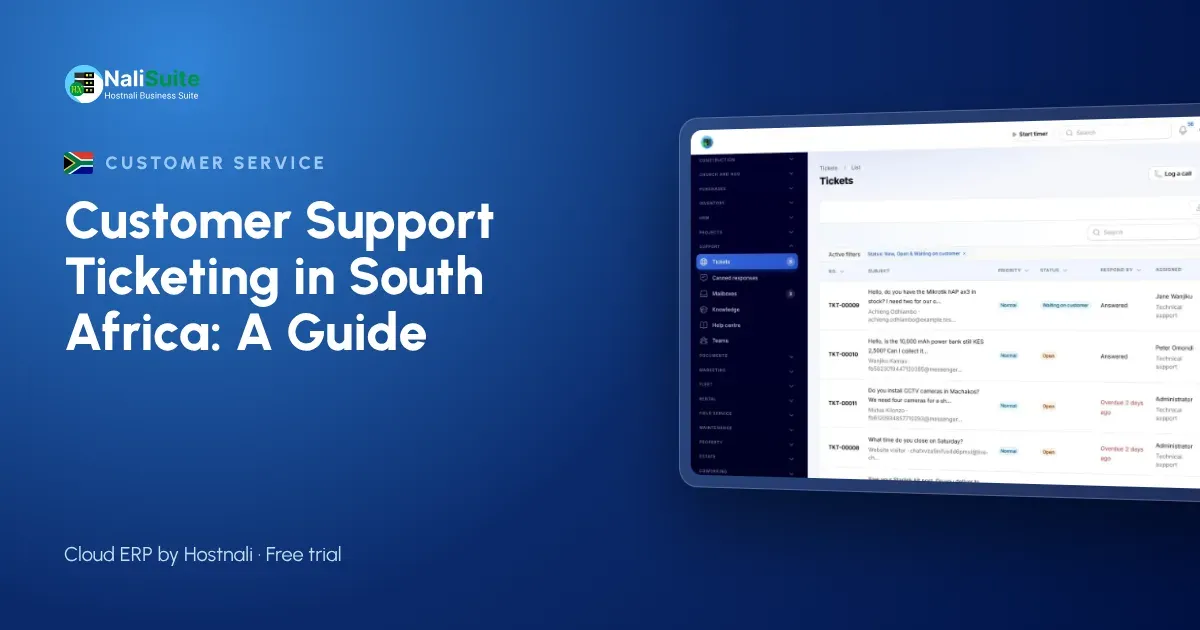
It stops requests getting lost and makes it clear who is handling each one. In NaliSuite Helpdesk, every phone call, email, web form, live chat, Facebook, Instagram or WhatsApp message becomes a ticket in one inbox. Each ticket has an owner, a priority, a status and its full history.
Before the switch, the Durban company kept a paper call log at reception and a separate list on the office manager’s computer. When a customer called back to ask when the technician was coming, nobody could find the original request quickly.
How do we decide what is urgent?
Agree on a few priorities based on the impact for the customer, not on who shouts loudest. For the appliance company:
- Urgent: a restaurant’s cold room or main fridge has failed.
- High: a household fridge or stove is not working.
- Normal: a washing machine fault, a service booking.
- Low: a quote request or general question.
Helpdesk tracks first-response and resolution targets for each priority and escalates tickets that are about to miss them, so the restaurant with a failed cold room is never left behind a quote request.
How do tickets reach the right person?
Set up teams and let tickets route to them. The Durban company has a Bookings team, a Parts and warranty team and an Accounts team. Within each team, tickets can be shared out by round robin so the work spreads evenly.
When a repair needs a technician, the job can be dispatched with the Field Service add-on, which sends jobs to technicians, lets them work from a phone and invoices labour and parts. The ticket keeps the conversation with the customer; the job keeps the work.
How do we reply faster?
Two tools do most of the work:
- Canned replies. Answers to everyday questions, such as call-out areas, booking times and how warranty repairs work, are saved once and used by everyone.
- AI drafts. With the AI Business Assistant add-on, a reply is drafted from the conversation and your help articles. The agent checks and edits it before sending. The add-on runs on your own Anthropic API key.
Can customers help themselves?
Yes, and many prefer it. Publish knowledge base articles in a public help centre and in the customer portal: how to reset a washing machine, what to check before booking a call-out, how load-shedding can affect appliances. In the portal, customers also follow their own tickets and see and pay invoices.
Every article that answers a common question is a phone call your call centre does not have to take.
Can we charge for support time?
Yes. Agents and technicians can log time on tickets, and that time can be billed. For restaurants on a service contract, the company invoices from NaliSuite Invoicing with an online payment option through its payment provider, so clients can pay by card or instant EFT.
How do we know if support is getting better?
Look at a few numbers every week:
- Tickets per day, by channel and by team.
- Time to first reply.
- Tickets that broke their targets.
- Customer ratings after a ticket is resolved.
After two months, the Durban company found that Monday mornings and the days after a public holiday brought double the usual calls. It now rosters an extra agent on those days.
What about POPIA?
Tickets contain names, phone numbers, addresses and sometimes photos of appliances in people’s homes. That is personal information under POPIA. Keep it in the helpdesk rather than on staff phones and personal email, and limit access to the teams that need it.
Restaurants on service contracts
The company’s restaurant clients are its most valuable and its most demanding. Their tickets carry a tag for the contract, so the team can see at a glance how many call-outs each restaurant has had this month and whether a recurring fault needs a replacement rather than another repair. That conversation goes much better with the ticket history in front of you.
Frequently asked questions
Can phone calls be logged as tickets?
Yes. Phone is one of the channels in Helpdesk, so an agent logs each call as a ticket with the customer’s details.
Can WhatsApp messages come into the same inbox?
Yes. Connect your business number through the WhatsApp Business Cloud API. See the WhatsApp feature.
Do we need to replace our phone system?
No. Keep your phones; agents simply log each call as a ticket so it is tracked like everything else.
Try NaliSuite
Every NaliSuite plan includes Helpdesk, Invoicing and the customer portal, from R 38 a month. Look at the plans and run your support desk in it during the free trial.